
Why choose a miniature linear motor? When a mechanism must move directly and precisely within a tight space, this actuator can offer a useful alternative to rotary motion and mechanical conversion. A miniature linear motor can move a lens carriage, inspection sensor, or small positioning stage along a straight path. You can see the design benefit in the hardware: fewer gears, less backlash, and a compact motion path. Yet small size alone is not a reason to choose one.
Professor Jacek F. Gieras has published extensively on linear motors, including in Linear Motors: Transportation and Automation Systems. An editorial paraphrase of the engineering considerations in that work is: “Choose the actuator by its required force, travel, speed, and heat—not by package size alone.” This is a paraphrase, not a verbatim quotation. It points to the questions that matter: How far must the load travel? How quickly must it settle? How much heat can the surrounding assembly tolerate?
The answers depend on the application. A short, rapid movement may demand different force and control than a slow, steady adjustment. Mounting, cables, and thermal limits also take real space. That detail is easy to miss. A miniature linear motor may simplify a mechanism, but it does not remove the need for careful sizing or testing. Engineers should compare the motor’s force, stroke, speed, and operating conditions with the actual load. Then they can judge whether compact, direct motion justifies the added control and integration work.
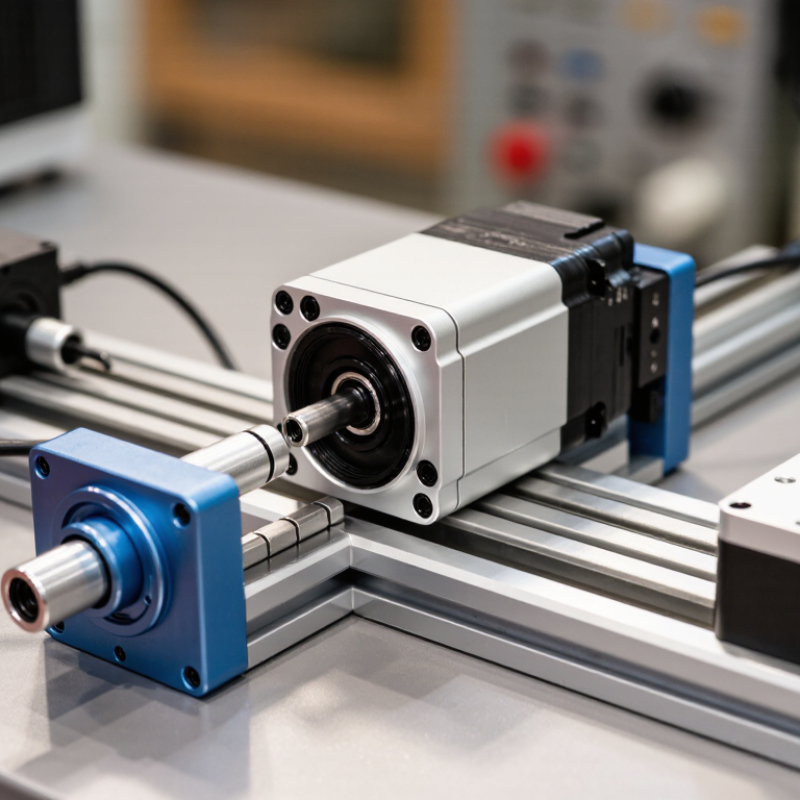
A miniature linear motor is a compact actuator that produces motion along a straight path. Unlike a rotary motor paired with a screw or belt, it creates linear force directly. Its moving part may be a magnet, a coil, or a small carriage, depending on the design. The term “miniature” has no single size limit across the industry. It usually describes a motor built for tight spaces, such as a handheld instrument or a small optical assembly. Small is relative. A motor that fits inside a palm-sized device may still be too large for a lens mechanism.
What defines the motor is not size alone, but how it converts electrical input into controlled travel. Some designs move a short distance quickly; others prioritize smooth, repeatable positioning. A useful specification should state stroke, force, speed, resolution, and duty cycle, rather than relying on a compact label. For example, a mechanism moving a tiny lens needs steady motion and little vibration, while a miniature valve may need enough force to overcome spring pressure. Heat and mounting details matter too: a motor tested freely may behave differently once fixed inside a warm enclosure. The word miniature can suggest precision, but it does not guarantee it. I would check the actual motion requirements before treating the name as a performance claim.
| Design Dimension | Miniature Linear Motor | Comparison or Practical Consideration |
|---|---|---|
| What defines it? | A compact motor that produces motion directly along a straight path. “Miniature” describes the application and compact scale; there is no single industry-wide size cutoff. | Check the motor’s actual dimensions, travel, force, and thermal limits rather than relying on the word “miniature.” |
| Motion mechanism | Electromagnetic force moves a forcer or mover along a linear track or guide. | A rotary motor with a lead screw or belt converts rotary motion into linear motion through a mechanical transmission. |
| Mechanical transmission | Direct-drive designs can move the load without a lead screw, gearbox, or belt. | Fewer transmission components can reduce backlash and wear, but a guide or bearing may still be needed to support the load. |
| Positioning behavior | Can provide smooth, controllable motion; achievable accuracy and repeatability depend on the motor, encoder, controller, guide, and installation. | A screw-driven stage can also achieve precise positioning. Its performance depends on screw pitch, preload, encoder arrangement, and mechanical condition. |
| Speed and acceleration | Direct drive can support rapid motion and acceleration when the motor, payload, power supply, and control system are appropriately sized. | Screw, belt, and guide limits may constrain speed or acceleration. No technology is automatically faster in every application. |
| Force and load | Available continuous and peak force vary substantially by motor design, cooling, duty cycle, and operating conditions. | Compare continuous force—not just peak force—and check the guide’s allowable load and moment capacity. |
| Travel range | Travel is determined by the active magnetic track, motor geometry, and system layout; compact designs may prioritize a short working stroke. | Screw- and belt-driven stages can offer a broad range of travel lengths. Confirm the required stroke and overall installed length. |
| Motion smoothness | Ironless and voice-coil designs can provide low-cogging motion. Other linear-motor designs may exhibit force ripple. | Choose the motor architecture to suit the application: low-speed smoothness, force, stroke, and thermal performance can involve trade-offs. |
| Maintenance | Removing a screw or belt can reduce maintenance associated with those transmission parts, though guides, cables, and bearings may still require care. | Maintenance requirements depend on the complete motion system, environment, lubrication, duty cycle, and cleanliness requirements. |
| Key selection checks | Evaluate stroke, payload, force, speed, acceleration, positioning requirements, duty cycle, heat dissipation, feedback, and available space. | Compare complete systems under the intended operating conditions. Published peak ratings alone are not sufficient for selection. |
| Typical applications | Compact precision positioning, inspection equipment, laboratory instruments, small automation systems, and short-stroke handling. | Best suited when direct drive, smooth motion, or reduced transmission backlash is valuable and the system can accommodate the motor and control requirements. |


© 2024 Sierramotion. All Rights Reserved