Choosing the best cylindrical linear motor in China requires more than comparing catalog prices. The right choice affects positioning accuracy, cycle time, heat control, and machine uptime. According to the International Federation of Robotics’ World Robotics 2024 report, China installed 276,288 industrial robots in 2023. This large automation base is increasing demand for compact, responsive motion systems.
A cylindrical linear motor can replace rotary transmission parts in selected applications. It may reduce backlash, mechanical wear, and maintenance points. However, these benefits depend on correct sizing. Engineers should examine continuous force, peak force, stroke length, acceleration, duty cycle, and cooling conditions. Feedback resolution also matters when the machine handles wafers, lenses, batteries, or precision assembly parts. A motor that performs well in a laboratory may overheat beside a sealed production enclosure.
Look beyond attractive specifications.
Industry reports from MarketsandMarkets and Grand View Research indicate continued growth in the global linear motor market, driven by semiconductor equipment, robotics, packaging, and factory automation. Their market categories are broader than cylindrical designs, so their figures should not be treated as product-specific proof. This is an important limitation. Supplier evaluation should include load tests, thermal curves, encoder compatibility, protection ratings, and field-service capability in China. Ask for measured data, not only theoretical force charts. A reliable manufacturer should explain tolerances, winding life, repair procedures, and delivery consistency. In practice, the cheapest option can become expensive after repeated alignment problems. Yet premium pricing alone proves nothing. Careful testing remains essential.
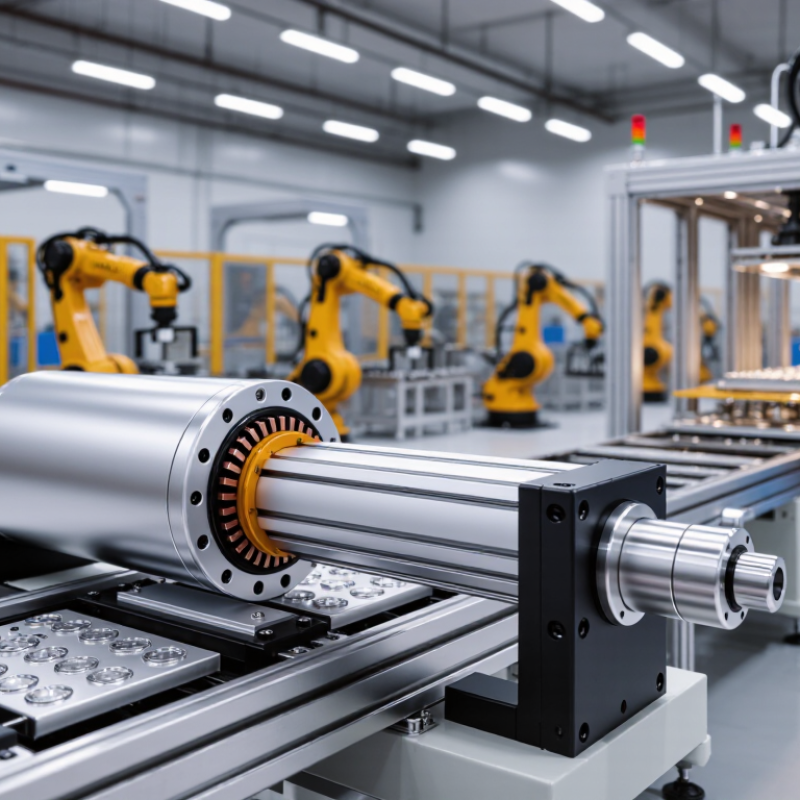
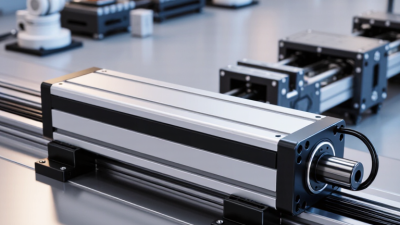
A cylindrical linear motor creates straight-line motion without a ball screw, belt, or rack. Its tubular structure usually contains a permanent-magnet shaft and a surrounding coil assembly. When controlled current enters the coils, magnetic fields pull or push the shaft along its axis. Position changes almost instantly.
This design reduces mechanical contact and backlash. It can deliver clean acceleration in semiconductor tools, medical equipment, and precision automation. A 2023 MarketsandMarkets report valued the global linear motor market at about USD 1.3 billion and projected roughly 9% annual growth through 2028. Cylindrical motors represent only part of this market, so the figure should not be treated as their direct sales value.
In practical selection, compare continuous force, peak force, stroke, speed, and thermal limits. Ask for force curves, encoder accuracy, duty-cycle data, and test conditions. Cooling matters more than many buyers expect. A compact motor may reach high peak force, then lose performance after several minutes. It happens.
The installation environment also changes the decision. Dust, vibration, cable movement, and vertical loads can affect service life. Reports from the International Federation of Robotics continue to show strong automation demand, but market growth does not guarantee a suitable motor. I would request sample testing from a Chinese supplier before approving volume production. Datasheets are useful, yet real acceleration profiles often expose missing details.

A cylindrical linear motor converts electromagnetic force directly into linear motion. The chart shows practical reference ranges for selecting a motor according to force, speed, acceleration, and stroke requirements.
Higher continuous force is suitable for heavier payloads, while higher peak force and acceleration support fast positioning. Speed and stroke should be selected according to the machine cycle, available installation space, and required positioning distance. These are general engineering reference ranges rather than specifications for a particular company or brand.
How to Choose the Best Cylindrical Linear Motor in China?
Which Performance Specifications Matter for Your Application?
Choosing a cylindrical linear motor in China starts with your machine’s real operating conditions. The required continuous force matters more than the advertised peak force. A motor may reach high thrust for a few seconds, then overheat during repeated cycles. Define the load, stroke length, acceleration, and working frequency before comparing suppliers. Small details matter.
Speed alone can mislead. Check acceleration, deceleration, and force stability across the full travel range. For pick-and-place equipment, repeatability and settling time may matter more than maximum speed. For pressing or dispensing, continuous force and low-speed smoothness deserve closer attention. Ask for measured curves, not only catalog values. Test data should identify temperature, load, and measurement conditions.
Thermal performance often decides long-term reliability. Review the duty cycle, cooling method, winding temperature, and allowable ambient temperature. Confirm whether the feedback device matches your controller and required positioning accuracy. Cable bending radius, protection rating, and installation tolerance also affect field performance. A supplier should provide inspection records, dimensional drawings, and sample testing support. In practice, specifications can look complete while missing thermal limits or encoder accuracy. That gap deserves questions. Mistakes happen.
Choosing the best cylindrical linear motor in China starts with a careful design comparison. Different suppliers may use similar force ratings, yet their motors can behave differently under continuous loads. I examine continuous force, peak force, stroke length, speed, acceleration, and duty cycle together. A motor producing strong peak force may overheat during repeated movement.
I also compare cooling methods, encoder resolution, bearing guidance, and moving-mass design. Air cooling may suit short cycles, while water cooling can support demanding production equipment. Check the motor’s temperature rise after several hours, not only during a short demonstration. I once trusted a catalog speed and overlooked acceleration limits. That mistake changed the required motor size.
Supplier testing in China deserves close attention. Request measured data, test conditions, tolerance ranges, and inspection records. A useful sample test should repeat the real stroke, payload, cycle time, and mounting position. Listen for vibration near the stroke ends. It often reveals alignment problems. Review communication quality, replacement procedures, documentation, and delivery consistency. A clean drawing is helpful, but it does not prove stable manufacturing. Comparing samples from different factories can expose small differences in thrust ripple, noise, and thermal performance. These details matter when a linear stage must hold position within a few micrometers.
| Comparison Dimension | Tubular Ironless Design | Tubular Iron-Core Design | Tubular Voice-Coil Design | Typical Selection Guidance |
|---|---|---|---|---|
| Operating principle | Permanent-magnet rod and coil assembly produce direct linear force without iron teeth. | Iron magnetic circuits increase force density but introduce cogging force. | Short-stroke electromagnetic actuator designed for bidirectional force and precise positioning. | Match the motor topology to stroke, force, speed, and motion smoothness requirements. |
| Typical continuous force range | Approximately 10–300 N for compact and medium-size assemblies. | Approximately 50–1,000 N, depending on diameter, winding, and cooling. | Approximately 5–200 N for common short-stroke applications. | Use the manufacturer’s tested continuous-force curve rather than peak force alone. |
| Peak force capability | Often 2–3 times the continuous rating for short duty cycles. | Often 2–3 times the continuous rating when thermal limits are respected. | Typically 2–4 times the continuous rating for brief acceleration or impact events. | Verify peak duration, duty cycle, current limit, and driver protection settings. |
| Typical speed capability | Up to approximately 2–5 m/s in suitable mechanical systems. | Approximately 1–3 m/s in force-oriented applications. | Commonly below 1 m/s, although short-stroke acceleration can be high. | Confirm speed at the required load, not only the no-load maximum. |
| Common stroke range | Approximately 50–1,000 mm, with longer strokes possible through modular construction. | Approximately 50–1,500 mm, depending on rod length and magnetic pitch. | Typically 5–100 mm; longer travel is less common. | Select a tubular linear motor when direct drive and a compact long-travel axis are important. |
| Motion smoothness | Very smooth because there is little or no cogging force. | Good, but cogging and force ripple may require compensation. | Very smooth and well suited to low-speed force control. | Prefer ironless or voice-coil designs for inspection, dispensing, and precision handling. |
| Positioning accuracy | Determined mainly by the encoder, mechanics, controller, and thermal stability; sub-millimeter to micron-level systems are practical. | Can achieve comparable accuracy, but cogging and thermal growth require careful tuning. | High repeatability is practical over short strokes when paired with a suitable feedback sensor. | Specify repeatability, accuracy, settling time, and measurement conditions separately. |
| Thermal management | Natural or forced-air cooling is common; continuous force decreases as winding temperature rises. | Air cooling is common; water cooling may be required for high continuous force. | Usually air-cooled because of the short stroke and compact size. | Request force-versus-temperature data and the rated winding-temperature limit. |
| Mechanical guidance requirement | External linear guides are required because the motor does not normally support side loads. | External guides are also required for accurate and safe motion. | Guidance is required unless the actuator is integrated with a suitable bearing system. | Check allowable radial load, moment load, bearing life, and alignment tolerance. |
| Electrical requirements | Three-phase current-driven operation is common; winding resistance and inductance vary by model. | Three-phase servo drives are common, with higher current demand at high force. | Often operated with a linear amplifier or servo drive configured for current control. | Confirm bus voltage, continuous and peak current, feedback type, and drive compatibility. |
| Environmental suitability | Suitable for clean automation; sealing and corrosion protection must be specified for humid or dusty areas. | Suitable for industrial automation when the magnetic assembly and cooling system are protected. | Suitable for clean, controlled environments unless a protected construction is selected. | Ask for IP rating, operating temperature, humidity range, and contamination resistance. |
| Primary advantages | Low cogging, low moving mass, quiet operation, and good high-speed performance. | High force density, strong acceleration, and good suitability for heavy payloads. | Compact construction, excellent controllability, and smooth low-speed force output. | Choose based on total system performance rather than motor force alone. |
| Main limitations | Lower force density and possible sensitivity to external magnetic fields. | Cogging force, magnetic attraction, higher heat generation, and greater tuning complexity. | Limited stroke and lower continuous-force capability than many iron-core designs. | Evaluate the complete axis, including guides, encoder, drive, cooling, and installation labor. |
| Typical applications | Pick-and-place equipment, inspection, semiconductor handling, laboratory automation, and precision stages. | Machine tools, heavy-duty automation, packaging, robotic axes, and high-throughput material handling. | Optical focusing, valve actuation, vibration control, lens positioning, and short-stroke testing equipment. | Select the design that meets the actual duty cycle and load profile. |
| Key checks when sourcing in China | Request test curves, dimensional drawings, winding data, encoder options, sample testing, and export packaging details. | Confirm cooling interfaces, magnetic-force data, cogging measurements, assembly tolerances, and overload limits. | Confirm stroke, force linearity, thermal time constant, amplifier compatibility, and feedback integration. | Compare verified test data, quality-control procedures, lead time, technical support, warranty terms, and spare-part availability. |
Note: The numerical ranges are representative engineering ranges for cylindrical linear motor designs and are not tied to any specific company or brand. Actual performance depends on motor diameter, winding, stroke, duty cycle, cooling, drive settings, encoder resolution, and mechanical load.
Choosing a cylindrical linear motor in China begins with checking the manufacturer, not the catalogue. Ask for measured thrust curves, force ripple data, winding temperature limits, and repeatability results under stated loads. A graph without test conditions is decoration. Request a sample motor and matching driver. Run it through your real duty cycle: acceleration, pauses, reverse motion, and heat buildup. Record noise and position error after several hours.
Examine engineering control at the factory. Can the supplier explain magnet grade, coil insulation, shaft straightness, bearing life, and encoder alignment in practical terms? Request drawings with tolerances, material records, inspection plans, and serial-number traceability. Check whether production testing uses calibrated instruments. Calibration matters. A clean workshop helps, but it does not prove consistency. Review recent batch records, not only a carefully prepared sample.
Evaluate communication and service before placing a large order. Confirm response times, spare-part availability, firmware support, packaging protection, and realistic lead times in writing. Ask how failures are analyzed and reported. Vague answers deserve caution. Verify export documentation and the manufacturer’s ability to meet your destination’s applicable standards. Factory audits, video inspections, or an independent quality agency can reveal gaps. Do not rely on price alone; low initial cost may hide unstable tolerances, redesign work, or difficult warranty discussions. Your checklist may still miss something. Leave room for a pilot order and corrective action.
Choosing the best cylindrical linear motor in China requires more than comparing catalog prices. Quality begins with traceable materials, stable winding processes, and complete test records. Ask for force curves, positioning accuracy, thermal data, and life-test results. A serious manufacturer should explain testing conditions clearly, not hide behind general claims. Request a sample inspection before placing a large order.
Cost needs a wider view. A low unit price may exclude controllers, cables, cooling parts, tooling, or installation support. Compare the total cost over the motor’s working life. Check energy use, maintenance frequency, rejected parts, and replacement time. I have seen attractive quotes become expensive after small items were added. Measure twice. Keep records.
Delivery depends on real capacity, not only a promised date. Confirm production stages, inspection time, packaging details, and shipping documents. Ask how delays are communicated. After-sales support matters when a motor vibrates during commissioning or loses force under heat. Look for remote troubleshooting, spare-part availability, repair procedures, and response times in writing. One practical test is to send a technical question before ordering. The speed and precision of the reply reveal useful information. No supplier is perfect. I have also misjudged fast replies that lacked engineering depth. For that reason, verify support with references, test reports, and a small pilot order before scaling production.
Sierramotion engineers help customers design solutions to complex motion problems. Whether a simple coil, or a precision motion assembly working in vacuum, Sierramotion has the experience to create a solution that works the first time.