
A pinball machine is more than a cabinet filled with lights, sounds, and moving parts. It is a carefully connected mechanical and electronic system. Players launch a steel ball onto a playfield, then use flippers to keep it moving. Bumpers, slingshots, ramps, targets, and magnets change its path. Beneath the surface, switches detect contact and send signals to a control system. That system manages scoring, lighting, sound effects, timers, and game rules. The experience feels immediate because every action produces a visible response.
Pinball historian and designer Roger Sharpe famously described pinball as “a game of skill.” His view helps explain why timing, observation, and controlled reactions matter. A strong player watches the ball’s speed and angle, not just the score. The machine also offers feedback through flashing lamps, sharp bell tones, and the brief vibration of a bumper. These details make the rules easier to feel, even when they are difficult to understand. Modern Pinball Machines may include digital displays, computer-controlled features, and complex software, while older models depend more heavily on relays and physical switches. Still, their central principle remains similar: a player influences a moving ball within a limited space. This article will explain how that relationship works, from the plunger and playfield to the sensors and scoring logic. The explanation will not cover every design variation. Real machines can be surprisingly inconsistent. That imperfection is part of their character, but it can also make troubleshooting challenging.
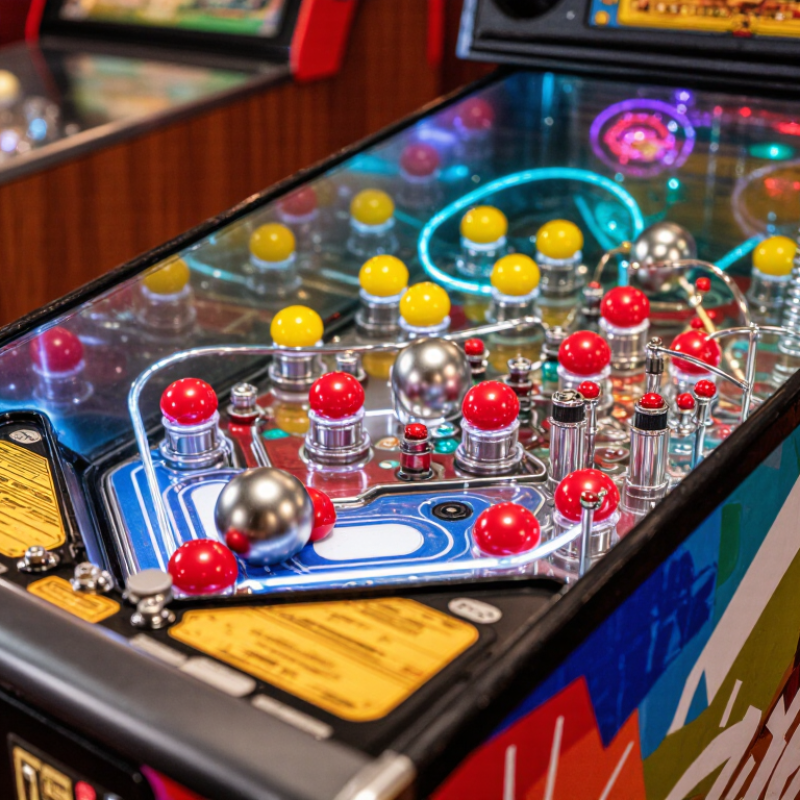
A pinball machine is an electromechanical game built around one metal ball, a sloped playfield, and player-controlled flippers. The cabinet usually contains a glass-covered surface, rubber bumpers, targets, ramps, sensors, lights, speakers, and a scoring display. When the ball rolls downhill, gravity supplies the motion. The player uses buttons to activate solenoids, which move the flippers upward in milliseconds. Other coils strike bumpers or release gates when electrical switches detect contact. It feels physical, yet a small computer quietly coordinates nearly every event.
The definition is not perfectly tidy. Older machines relied more heavily on relays and mechanical scoring, while modern machines combine sensors with programmed rules. According to Grand View Research’s 2024 arcade gaming market analysis, the broader global arcade gaming market reached about 4.3 billion dollars in 2023. Pinball represents only one segment, but the figure shows the commercial scale of location-based play. The International Flipper Pinball Association also maintains a large global tournament database, reflecting structured competition and measurable player skill.
Stand beside a working machine, and the design becomes clearer. A missed shot can return through the outlane, while a controlled bounce may send the ball toward a ramp. The player is not simply reacting; they are managing risk, timing, and angles. Sensors record the ball’s path imperfectly, too. A dirty switch or worn rubber can change the result. That weakness matters. Pinball is engineered precision, but it still depends on maintenance, judgment, and a little uncertainty.
| Data Dimension | Typical Specification or Fact | How It Works |
|---|---|---|
| Definition | Electromechanical or electronic arcade game | A player launches one or more steel balls onto an inclined playfield and uses controls to keep the ball in play while scoring points. |
| Playfield Angle | Usually about 6° to 7° from horizontal | The incline uses gravity to move the ball toward the lower part of the playfield while allowing ramps, targets, and other features to redirect its path. |
| Ball Material | Hardened steel | The ball is durable, highly elastic during collisions, and conductive enough to interact with switches and sensors in many machine designs. |
| Ball Diameter | Approximately 27 mm | The standardized ball size allows it to travel through commonly sized lanes, guides, holes, ramps, and mechanisms. |
| Ball Mass | Approximately 80 g | The ball's mass provides momentum for triggering targets, activating mechanisms, and rebounding from posts and bumpers. |
| Cabinet Construction | Wood-based cabinet with a glass-covered playfield | The cabinet supports the playfield, electronics, lighting, speakers, coin or start controls, and the lower service area. |
| Playfield Surface | Painted or printed playfield with plastic and metal components | The surface contains lanes, posts, guides, targets, ramps, holes, lights, and interactive devices that determine the ball's route and scoring events. |
| Flippers | Usually two main lower flippers | Button-operated solenoids rotate the flippers rapidly, allowing the player to strike the ball upward and prevent it from falling through the drain area. |
| Flipper Control | Left and right cabinet buttons | Each button activates the corresponding flipper coil or motor circuit. The player times the controls to aim shots and protect the ball. |
| Ball Launcher | Manual plunger or electronic launcher | The launcher supplies the initial force that sends the ball from the shooter lane onto the playfield. |
| Bumpers | Round, spring-loaded scoring devices | When the ball enters a bumper, a switch detects contact and a coil briefly moves the bumper skirt or ring, propelling the ball away and awarding points. |
| Slingshots | Two triangular rebound devices above the flippers | Contact with a slingshot switch activates a solenoid that kicks the ball sideways, often producing a score and a rapid change in direction. |
| Targets and Switches | Fixed, drop, rollover, and lane switches | Mechanical or electronic switches detect ball contact. The control system then records the event, changes the score, lights features, or starts a game mode. |
| Ramps and Lanes | Guided routes made from metal or molded plastic | They direct the ball to different playfield areas and may award points, return the ball to the shooter lane, or activate additional gameplay features. |
| Scoring System | Electronic score counter | A central control system adds points when switches, targets, bumpers, ramps, or other programmed events are triggered. |
| Control System | Dedicated electronic controller with programmed rules | The controller reads switch inputs, operates coils and lights, manages sound, tracks balls, and applies the machine's scoring rules. |
| Solenoids | Electromagnetic actuators | When energized, a solenoid creates a magnetic field that moves a plunger. This action powers flippers, bumpers, kickers, drop targets, and other mechanisms. |
| Lighting and Sound | LED or incandescent lights with electronic audio | Lights and sounds provide feedback about scoring, completed objectives, warnings, ball status, and special gameplay events. |
| Tilt Mechanism | Motion-sensitive safety device | Excessive shaking, lifting, or moving of the cabinet can trigger the tilt system, ending the current ball or disabling scoring to discourage physical manipulation. |
| Ball Drain | Lower central area between or below the flippers | If the player fails to hit the ball with the flippers, gravity carries it into the drain, where a sensor registers the end of the ball. |
| Typical Ball Count | Commonly three balls per game | The machine tracks each ball and starts the next one after a drain until the configured number of balls has been used. |
| Power Supply | Mains electricity converted to low-voltage circuits | The power system supplies separate electrical levels for logic, lighting, audio, switches, and high-current solenoids, with protective fuses and circuitry. |
| Player Objective | Maximize score and complete programmed objectives | Players combine accurate flipper timing, controlled shots, rebounds, and risk management to score points and activate bonuses or multiball features. |

© 2024 Sierramotion. All Rights Reserved