Call Today: 916-259-1868

What Is Competitive Robotics and How Does It Work?

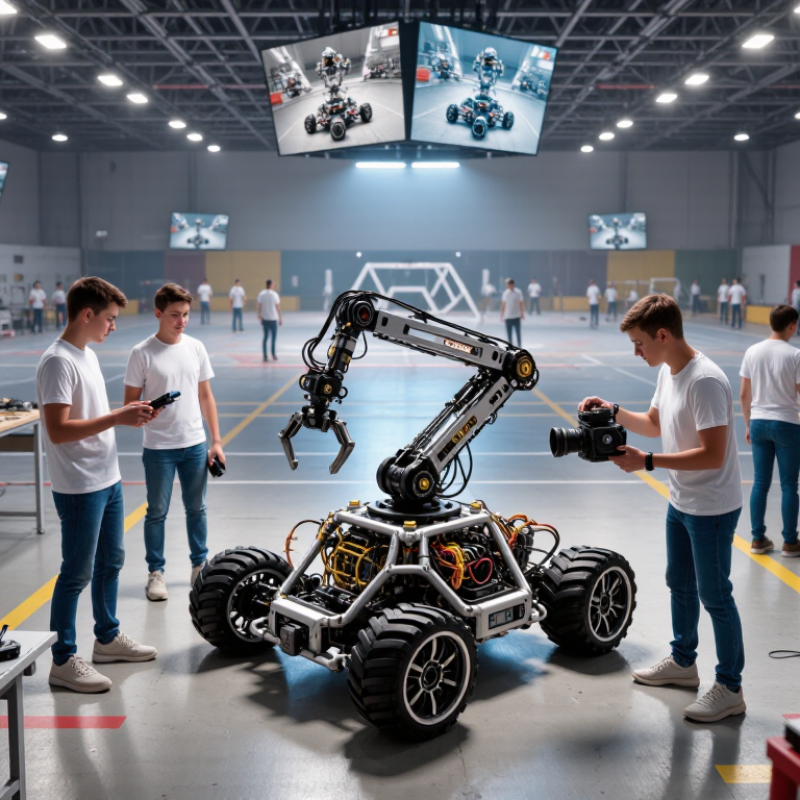
Competitive Robotics turns engineering into a visible test of judgment, teamwork, and machine control. Teams design, build, program, and repair robots under strict rules. A match may involve a six-wheel platform, a camera-guided arm, and seconds of frantic decision-making. The objective is not simply to build a powerful machine. Reliability, strategy, safety, and cooperation often decide the result.

The International Federation of Robotics reported 541,302 industrial robots installed worldwide in 2023. Its World Robotics 2024 report also recorded more than 4.28 million industrial robots operating globally. These figures describe industry, not competition directly. Still, they show the expanding technical environment that competitive teams are entering. Students now work with sensors, autonomous navigation, embedded software, and increasingly capable artificial intelligence tools.

Ken Goldberg, a robotics professor at the University of California, Berkeley, observed, “Robots are not going to replace humans, but robots will make their jobs easier.” That idea fits the competition floor. A robot may identify a target independently, yet a human driver still chooses timing, risk, and recovery. The partnership is imperfect. That matters.

This guide explains what Competitive Robotics is, how matches operate, and why preparation extends beyond construction. It examines common competition formats, scoring systems, control methods, team roles, and technical failures. Readers will also see where published data becomes limited. Competitive robotics is not one standardized industry. It is a broad ecosystem of school leagues, university contests, research events, and professional challenges. Understanding that difference prevents impressive numbers from creating a misleading picture.

What Is Competitive Robotics and How Does It Work?

What Competitive Robotics Means and What It Involves

What Is Competitive Robotics and How Does It Work?

Competitive robotics is a structured activity where teams design, build, program, and operate robots for defined challenges. The goal is not simply to create a machine that moves. Teams must solve problems under time limits, technical rules, and changing match conditions. A typical project may involve sketching a lifting arm, selecting suitable motors, writing control code, and testing movement on a marked field.

The work combines engineering, communication, and careful decision-making. Students often divide responsibilities, but effective teams understand every major system. A programmer should know how sensors affect movement. A builder should understand weight, balance, and maintenance. During testing, teams measure turning accuracy, battery performance, and response time. Small details matter. A loose connector can stop an otherwise capable robot.

Competitive robotics also teaches judgment through failure. A design can perform well in practice and fail during a real match. That experience encourages teams to record test results, inspect risks, and improve their process. Safety checks should cover moving parts, electrical connections, tools, and human positioning. Rules also require honest scoring and respectful cooperation with opponents. The process is not perfectly tidy. Teams may overlook a simple problem while chasing an advanced feature. That mistake can become useful evidence, if they examine it honestly and change the design. Reliable performance usually comes from repeated testing, clear documentation, and controlled improvements rather than one impressive idea.

What Is Competitive Robotics and How Does It Work?

Competitive robotics combines mechanical design, electronics, programming, and teamwork. A common match structure lasts 180 seconds and is divided into autonomous, driver-controlled, and endgame phases.

The chart shows a representative 180-second competition format: 30 seconds of autonomous operation, 120 seconds of driver-controlled play, and a 30-second endgame period. Exact timings vary by competition, but these phases reflect the way many events separate autonomous control, human control, and final scoring tasks.

The Main Parts and Design Principles of a Competition Robot

What Is Competitive Robotics and How Does It Work?

The Main Parts and Design Principles of a Competition Robot

Competitive robotics turns engineering choices into measurable match performance. A robot must move, sense, manipulate, and survive within strict rules. Most designs begin with a rigid chassis, driven wheels, motors, gears, and a protected power system. An onboard controller reads sensors and sends commands to motor controllers. Encoders track motion, while distance or vision sensors help the robot locate objects. Nothing works alone.

The manipulator is often the hardest subsystem. It may use an intake, arm, lift, gripper, or carefully shaped linkage. Designers balance reach against weight, speed, torque, and electrical demand. Lowering the center of gravity improves stability during sharp turns. Simple mechanisms usually offer easier repairs between matches. Elegant is not always reliable. Software coordinates autonomous routines, driver commands, sensor feedback, and safety limits. Clear state logic prevents a lift from moving before the chassis is ready.

Testing exposes the gap between a drawing and a working competition robot. Teams should measure cycle time, battery voltage, motor temperature, stopping distance, and repeated alignment accuracy. A useful test repeats the same task until small failures become visible. An early frame may seem strong, yet extra brackets can make acceleration painfully slow. That mistake deserves attention. Modular panels and accessible wiring shorten repairs when time is limited. Still, no design is perfect. A loose connector, weak joint, or overlooked software timeout can decide a match. Good engineering leaves room for inspection, adjustment, and honest criticism.

What Is Competitive Robotics and How Does It Work? — The Main Parts and Design Principles of a Competition Robot

A practical overview of the systems, specifications, and engineering principles commonly used in competition robots

System or Principle Main Function Typical Components Common Design Data Why It Matters in Competition
Chassis and Frame Supports the robot and transfers forces generated during driving, lifting, and contact with field elements. Extruded profiles, sheet metal, plates, brackets, fasteners, protective guards Approximately 10–25 kg for many educational and small-scale competition robots; frame clearance is often designed around the specific field rules. A rigid but lightweight frame improves acceleration, handling, serviceability, and resistance to impacts.
Drivetrain Moves and positions the robot on the competition field. Motors, gearboxes, wheels, axles, bearings, belts, chains, and motor controllers Typical wheel diameters range from 75–150 mm; gearing is selected to balance speed and pushing force. The drivetrain affects mobility, defensive strength, turning accuracy, and the time required to reach scoring locations.
Wheel Selection Determines traction, maneuverability, and interaction with the floor. Rubber or compliant wheels, omni wheels, mecanum wheels, traction wheels Traction wheels maximize forward force; omni and mecanum wheels reduce lateral resistance and enable more complex movement. Wheel choice should match the field surface, robot mass, required pushing force, and permitted driving style.
Power System Stores and distributes electrical energy to motors, sensors, and control electronics. Rechargeable battery, main fuse, power distribution board, switches, wiring, connectors Many competition platforms use a regulated low-voltage battery system, commonly around 12–24 V, subject to event rules. Reliable power delivery prevents brownouts, protects electronics, and keeps performance consistent throughout a match.
Motor and Actuator System Converts electrical energy into controlled mechanical motion. Brushed or brushless motors, gear reductions, linear actuators, servos, winches Gear reduction increases torque while reducing output speed; the required ratio depends on load, wheel size, and mechanism speed. Correct actuator sizing prevents overheating, stalled motors, slow cycles, and premature mechanical wear.
Manipulator or End Effector Collects, carries, lifts, places, launches, or otherwise interacts with game objects. Rollers, claws, intake belts, grippers, conveyors, elevators, arms, compliant surfaces Successful mechanisms typically prioritize repeatable alignment, controlled contact, and tolerance for small positioning errors. The manipulator directly determines scoring speed, object retention, and the robot’s ability to complete task-specific objectives.
Transmission Transfers power from motors to wheels or mechanisms. Gears, sprockets, chains, timing belts, shafts, couplers, pulleys Chain and belt systems require correct tension and alignment; gears provide compact power transfer but require accurate spacing. An efficient transmission reduces backlash, noise, energy loss, and unexpected failures during repeated match cycles.
Control System Processes commands and coordinates motors, sensors, and autonomous routines. Robot controller, motor controllers, input devices, communication modules, software Control loops may run at regular update intervals, while safety logic continuously monitors faults and operating limits. Good control architecture enables precise driving, smoother mechanisms, rapid troubleshooting, and reliable autonomous behavior.
Sensors Measures position, speed, distance, orientation, current, or contact conditions. Encoders, inertial sensors, limit switches, proximity sensors, cameras, current sensors Encoders provide rotational feedback; inertial sensors estimate heading; limit switches help define safe mechanical positions. Feedback allows the robot to correct errors instead of relying only on timed motor commands.
Autonomous Operation Executes programmed actions without continuous driver input. Preplanned trajectories, sensor feedback, state machines, motion profiles, vision processing Autonomous routines are commonly organized as sequential states such as align, acquire, transport, score, and reset. Reliable autonomous routines can produce early points, establish field position, and reduce dependence on manual reaction time.
Human–Robot Interface Allows operators to command the robot and monitor its condition. Handheld controller, buttons, joysticks, displays, status lights, diagnostic software Controls are usually mapped so high-frequency actions are easy to access and emergency stops are immediately available. Clear controls improve driver consistency, reduce cognitive load, and help operators respond quickly to changing match conditions.
Structural Design Maintains alignment and distributes loads across the robot. Cross-bracing, gussets, shafts, bearings, spacers, load-bearing plates High-load joints should be supported on both sides where possible and should minimize unsupported shaft length. Proper load paths reduce bending, vibration, fastener loosening, and alignment-related mechanism failures.
Weight and Center of Mass Influences stability, traction, acceleration, and resistance to tipping. Battery placement, ballast, low-mounted mechanisms, compact component layout A lower center of mass generally improves stability, while driven-wheel loading affects available traction. Balanced mass distribution helps the robot remain stable when carrying objects, extending mechanisms, or stopping quickly.
Safety and Compliance Protects people, equipment, and the robot while meeting competition requirements. Guards, fuse protection, emergency stop procedures, insulated wiring, software limits Robots must follow event-specific limits for size, mass, stored energy, electrical systems, and prohibited mechanisms. Compliance prevents inspection failures and reduces the risk of injury or match-disqualifying behavior.
Reliability and Maintenance Keeps the robot functional through repeated practice sessions and matches. Replaceable modules, inspection checklists, spare parts, cable management, access panels Designs that allow common components to be replaced with basic tools typically reduce pit and match recovery time. Competition results depend not only on peak performance but also on consistent operation under time pressure.
Modularity Allows mechanisms and electronics to be changed, tested, or repaired independently. Standard mounting patterns, detachable modules, labeled connectors, quick-release hardware Subsystems are often separated into drivetrain, intake, lift, electrical, and control modules. Modularity accelerates iteration, simplifies troubleshooting, and makes the robot easier to adapt to different strategies.
Design for Manufacturability Ensures that parts can be produced accurately with available tools and materials. Computer-aided design, laser-cut plates, 3D-printed parts, drilled profiles, standard hardware Parts should use realistic tolerances, accessible fasteners, and materials suited to the team’s fabrication capabilities. A manufacturable design is more likely to be completed, repaired, and reproduced before and during an event.
Testing and Iteration Identifies weaknesses and improves performance through controlled experiments. Practice fixtures, load tests, cycle tests, software logs, performance measurements Useful tests measure repeatability, cycle time, current draw, temperature, stopping distance, and failure frequency. Iterative testing converts design assumptions into evidence and reveals problems before competition day.
Strategic Optimization Aligns the robot’s capabilities with scoring rules, alliance roles, and match objectives. Task analysis, scoring cycle calculations, role allocation, defensive planning, failure contingencies Teams often compare cycle time, scoring reliability, travel distance, and probability of successful completion. The most effective robot is not always the fastest; it is the one that delivers reliable value within the rules and match strategy.

How Teams Build, Program, and Test Their Robots

What Is Competitive Robotics and How Does It Work?

Competitive robotics turns engineering ideas into machines that must perform under pressure. Teams build, program, and test robots for specific challenges. Their work combines mechanical design, electronics, software, communication, and careful planning.

A project often begins with clear requirements. The team measures field dimensions, identifies scoring tasks, and sketches possible mechanisms. Members may use computer-aided design before cutting materials. They select motors, sensors, batteries, wheels, and fasteners according to weight and performance limits.

During assembly, small details matter. Loose wires can stop an entire system. Poorly aligned gears can create heat and noise. No first design is perfect.

Programming gives the robot controlled behavior. Code reads sensors, adjusts motor speed, and guides movement. A control loop can help the robot follow a line or hold a steady angle. Teams test autonomous routines on marked practice areas. They record timing, errors, battery levels, and unexpected movement.

A rushed wiring change may pass one test and fail during competition. That failure deserves attention, not excuses. Teams should inspect electrical connections, protective guards, software limits, and emergency controls before every session.

Safe testing also keeps people outside the robot’s moving path. Repeated trials reveal weaknesses that confident guesses often miss.

Sometimes, the simplest mechanism performs better than an ambitious one. That lesson can be uncomfortable. Teams improve by documenting each change and challenging their own assumptions.

How Matches, Rules, and Scoring Shape Robot Performance

Competitive robotics turns engineering into a timed, rule-bound contest. A match may last only a few minutes, yet teams make decisions months earlier. Robots usually complete assigned tasks, move game pieces, or control specific zones. The rulebook defines legal dimensions, movement limits, contact, and scoring windows. Small details matter. A prototype that performs well in practice can fail after one overlooked restriction. Practical testing shows that teams gain more from studying rules than adding another motor.

Matches often begin with an automated period. During those seconds, sensors and preloaded code guide the robot without human input. A driver-controlled period follows, demanding quick judgment and steady communication. Referees award points for completed tasks, object placement, possession, or endgame positions. Some actions also create penalties, which can erase a strong lead. Scoring is rarely about speed alone. A reliable low-value action may outperform a spectacular maneuver that succeeds once.

Effective teams translate the scoring table into a simple match plan. They measure cycle time, battery drop, turning accuracy, and recovery after collisions. They also inspect field conditions, because loose pieces and changing light can confuse sensors. Careful plans can still collapse when drivers rush the final minute. That weakness deserves honest review. Practice should include failed runs, not only clean demonstrations. Coaches can compare recorded data with referee decisions and revise priorities. The best robot is not always the most complex one. It performs legally, repeatedly, and under pressure.

The Skills, Strategies, and Challenges Behind Competitive Robotics

Competitive robotics turns engineering into timed, public problem-solving. Teams design, build, program, test, and repair machines under strict deadlines. A match may expose a loose connector, weak gear, or flawed sensor reading. Small errors become expensive quickly. Skills extend beyond coding. Competitors need mechanical design, electronics, control systems, communication, and safe workshop habits. The World Economic Forum’s Future of Jobs Report 2025 says 39% of workers’ core skills may change by 2030. Analytical thinking remains a leading employer priority. That finding matches the competition floor, where teams must interpret data before making fast decisions.

Strategy matters as much as hardware. Strong teams study scoring patterns, estimate failure risks, and prepare backup actions. They also communicate clearly during noisy matches. The International Federation of Robotics reported 541,302 industrial robots installed worldwide in 2023, with more than 4.28 million operating globally. Competitive robotics reflects that wider need for reliable automation skills. However, practice is rarely perfect. A robot can succeed in testing and fail beside the field. That uncertainty deserves honest attention. Teams sometimes overbuild, chase speed, or ignore repair time.

Tips: Track every failure in a simple test log. Measure battery voltage, cycle time, and missed actions. Practice recovery, not only success. Assign one person to observe opponents, but question assumptions. The best strategy may still need revision. Keep spare connectors, fasteners, and tested code versions nearby. Test under noise, low battery, and rushed conditions. Those details reveal weaknesses early.