
Choosing the right Battery Liquid Cooling Pipe is a practical engineering decision, not a simple purchasing task. The pipe must move coolant steadily, resist pressure, and survive repeated heating and cooling. It also needs reliable connections near sensitive battery cells. Small details matter. Wall thickness matters. Bend radius matters.
Dr. Jeff Dahn, a respected battery researcher, has stated, “The battery is the most important component in an electric vehicle.” His point extends beyond cell chemistry. A battery pack also depends on controlled temperature, stable coolant flow, and durable thermal-management hardware. A poorly selected Battery Liquid Cooling Pipe may create uneven cooling, leakage risks, or unnecessary pressure loss. That can reduce performance and complicate maintenance.
This guide examines the factors engineers and manufacturers should compare before making a selection. These include material compatibility, operating temperature, coolant type, pressure rating, flexibility, vibration resistance, and connection design. Real installations deserve attention. A pipe passing close to sharp brackets needs protection. A pipe inside a compact pack may require tighter bends, but excessive bending can weaken it. No selection method is perfect. Testing assumptions is essential. Sometimes, a lighter pipe appears attractive but fails under long-term vibration. Sometimes, a stronger design costs more than the application needs. The correct choice balances safety, service life, manufacturability, and total system cost. Supplier documentation, sample testing, and traceable quality records should support that decision. Performance claims should never replace validation.
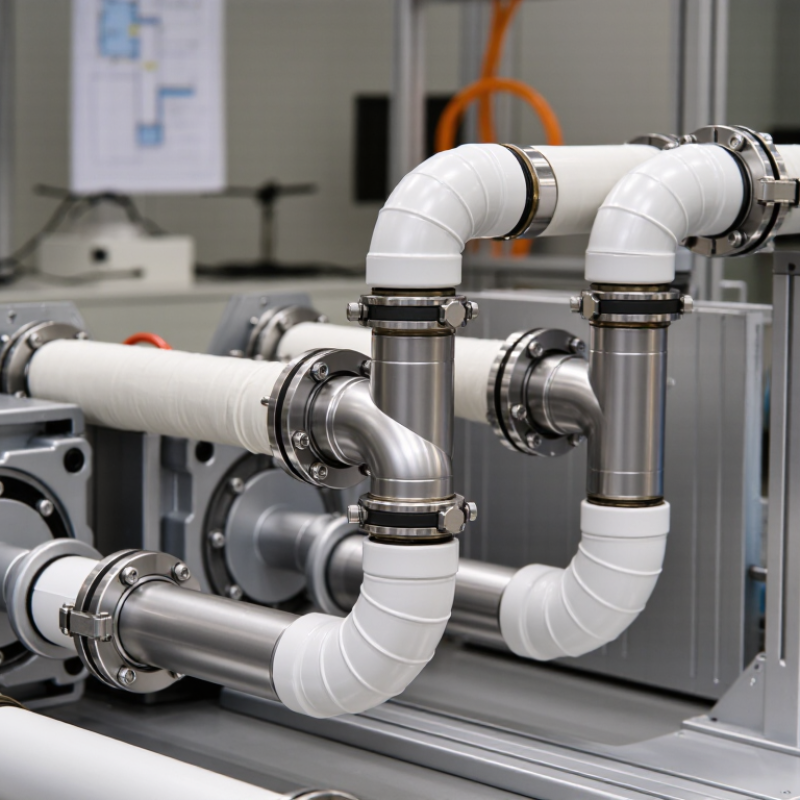
Liquid cooling pipes move heat away from battery cells during charging, driving, and rapid load changes. They help maintain a stable temperature across the pack. The International Energy Agency reported over 14 million electric cars were sold globally in 2023. That growth increases thermal control demands inside tighter battery enclosures.
The U.S. Department of Energy identifies roughly 15–35°C as a practical operating range for many lithium-ion battery systems. Pipes must support consistent coolant flow across this range. Engineers should examine pressure drop, flow rate, bend radius, wall thickness, and leak resistance. Material compatibility also matters. Aluminum, stainless steel, and engineered polymers behave differently under heat, vibration, and corrosion exposure.
A good pipe is not simply highly conductive. It must fit the pack without creating stress points. Thermal expansion can loosen joints over time. Poor routing may leave cells near the outlet warmer than cells near the inlet. I would validate this with flow testing, thermal imaging, and pressure cycling. A neat CAD model is not proof. Real packs behave less politely. Some designs still overlook service access, which can turn a small leak into a costly repair. Select the pipe after mapping heat generation, coolant chemistry, assembly limits, and long-term vibration conditions.

Choosing the right battery liquid cooling pipe starts with the battery’s actual thermal profile, not a catalog dimension. Measure heat generation during charging, discharge, fast charging, and idle periods. Record the highest and lowest coolant temperatures. Note it. A pack used in a warehouse faces different demands from one installed in a vehicle. Required cooling capacity, allowable pressure drop, flow rate, and temperature uniformity should be written into the design brief. In my experience, average temperature often hides brief hot spots near busbars or tightly packed cells.
Operating conditions determine whether a pipe remains reliable. Check ambient temperatures, vibration, installation space, bending radius, and expected service life. A pipe exposed to road salt, dust, or repeated thermal cycling needs suitable wall strength and chemical resistance. Coolant compatibility must be verified with the actual fluid, seals, and fittings. Do not rely on a generic compatibility chart alone. Small differences in additives can affect swelling or aging. Pressure testing should reflect real operating pressure, plus credible transient peaks. Use measured data when possible.
Thermal performance is only one part of the decision. The pipe must support safe assembly and consistent production. Inspect joints for leaks after routing, clamping, and vibration testing. Watch for kinks. I would also challenge the first design with an unfavorable case: low coolant flow, high ambient temperature, and a partially blocked channel. This scenario may feel excessive, yet it exposes weak assumptions. Document test methods, acceptance limits, and inspection frequency. If results are incomplete, say so clearly; unverified confidence is not engineering evidence.
How to Choose the Right Battery Liquid Cooling Pipe?
Pipe material determines heat transfer, flexibility, corrosion resistance, and service life. Aluminum conducts about 205 W/m·K, while stainless steel conducts roughly 15 W/m·K, according to ASM Handbook data. Aluminum therefore transfers heat efficiently, but it needs careful protection against galvanic corrosion. PA12 and other engineering polymers offer low weight and electrical insulation. Their thermal conductivity is much lower. IEA reported that global battery demand exceeded 750 GWh in 2023, rising over 40% year on year. That growth increases the need for reliable thermal systems.
Structure matters as much as material. Smooth-bore pipes usually reduce pressure loss and simplify cleaning. Corrugated pipes bend easily, but their internal ridges can increase turbulence and resistance. Multilayer designs can combine a strong outer shell with chemical resistance. Do not select by flexibility alone. Coolant compatibility must include glycol-water mixtures, dielectric fluids, additives, and operating temperatures. EPDM may suit common glycol coolants, while some silicone compounds resist heat but may allow greater gas permeation. Always check swelling, permeation, and connector compatibility. A laboratory result can still fail after vibration testing.
Tips: Measure actual pressure drop, not only catalog values. Check the fluid’s pH and electrical conductivity. Use thermal cycling and burst testing before approval. I would also question very thin walls; they reduce weight, but their fatigue margin may be easily overstated. Reference: IEA, Global EV Outlook 2024; ASM Handbook, Volume 2.
How to Choose the Right Battery Liquid Cooling Pipe?
Start with the heat load, not the pipe size. Calculate the required mass flow using Q = ṁ × Cp × ΔT. For a 20 kW cooling load, water-based coolant, and a 5°C temperature rise, the required flow is about 0.95 kg/s. Convert this value into volumetric flow using coolant density. Then select an internal diameter that keeps velocity practical, often around 1–2 m/s. Lower velocity reduces noise and erosion, while higher velocity may improve heat transfer but increases pressure loss.
Check the pipe using the Darcy-Weisbach equation: ΔP = f × (L/D) × (ρv²/2). Include every bend, connector, valve, and manifold. A short pipe can still lose pressure through restrictive fittings. Calculate Reynolds number and coolant viscosity at the actual operating temperature. Cold coolant behaves differently. The pump must overcome the total circuit loss, not only the straight pipe resistance. Leave a reasonable margin, but do not oversize blindly; excessive flow can waste pump energy and complicate control. My first estimate is rarely perfect, especially when fitting data is incomplete.
Tips: Measure the real route length. Confirm the smallest passage. Test flow and temperature during commissioning. A pressure sensor near the inlet can expose unexpected restrictions. Document assumptions, because coolant properties and battery heat output may change.
How to Choose the Right Battery Liquid Cooling Pipe?
Safety should guide every cooling-pipe decision. Check the pipe’s working pressure, burst pressure, and temperature range. These figures must match real battery-pack conditions, not only laboratory expectations. Examine chemical compatibility with the coolant, seals, and nearby insulation. A small swelling problem can become a serious leak. Pressure testing, vacuum testing, and helium or dye-based leak checks can reveal weak joints. Keep clear records of test results and production batches.
Durability depends on repeated stress. Look for evidence from thermal cycling, vibration, pressure pulsation, and coolant aging tests. The pipe should tolerate movement without sharp kinks or flattened sections. During installation, measure the bend radius carefully. Leave enough clearance near cell housings, busbars, and fasteners. Secure the pipe against rubbing, but avoid excessive clamps. Too much force can damage soft materials. I have seen neat installations fail because a connector carried unnecessary tension.
Quality standards matter beyond a certificate on paper. Ask for material data, dimensional inspection reports, cleanliness controls, and traceability records. Confirm that the supplier follows relevant automotive, pressure, and quality-management requirements. Inspect sample pipes yourself, including connector alignment and internal debris. A perfect specification is rare. Some test data may still need independent verification. That extra check can expose gaps before installation, when correction remains practical.
Sierramotion engineers help customers design solutions to complex motion problems. Whether a simple coil, or a precision motion assembly working in vacuum, Sierramotion has the experience to create a solution that works the first time.