
Choosing a Smart Street Light is not simply a matter of picking the brightest fixture. The right system must suit the road, nearby homes, local weather, and maintenance plan. A narrow residential street needs a different light distribution from a wide arterial road. A mismatch can create dark patches, glare, or unnecessary energy use.
Start by checking photometric data, not just wattage. Look for light distribution, color temperature, dimming range, and measured efficacy. Ask whether the fixture can maintain even illumination when output is reduced. Small details matter. A poorly placed sensor may respond to passing cars or tree movement instead of real activity. That can frustrate residents. Or waste power.
Controls also deserve careful review. Confirm how the Smart Street Light communicates, whether its platform supports practical integration, and what happens during a network outage. Examine the enclosure’s ingress and impact ratings, corrosion resistance, warranty, spare-part availability, and expected maintenance needs. Compare total ownership costs, including installation and servicing, rather than purchase price alone. Specifications can be misleading without site context. A short pilot on representative streets can reveal issues that a brochure will not. Review results with a qualified lighting professional and check applicable local requirements before choosing a system. No single model is best everywhere. The best choice is the one that meets real lighting needs, remains manageable over time, and performs reliably in local conditions.
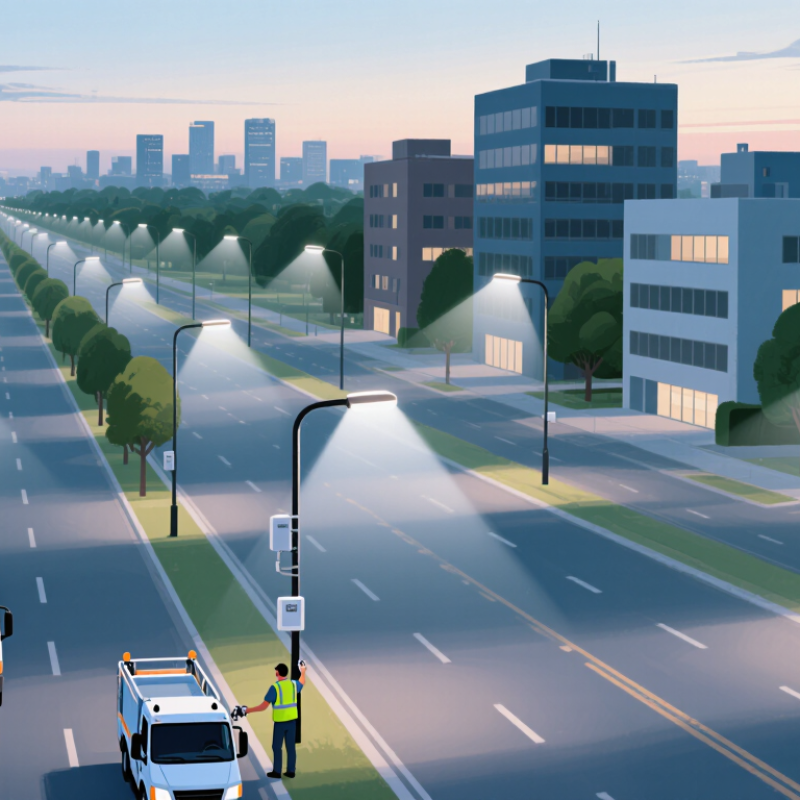
Before comparing smart street lights, define what each street needs after dark. Walk the route at night and note dark crossings, shaded bus stops, sharp bends, and doorways. A quiet residential lane may need different coverage from a busy road with frequent pedestrian crossings. Small details matter.
Set measurable goals for visibility, uniformity, energy use, and maintenance. The Illuminating Engineering Society’s ANSI/IES RP-8-22 guidance bases roadway lighting criteria on factors such as road type and pedestrian activity. Use those criteria to set targets, rather than choosing brightness by appearance alone. Record current operating hours and energy consumption too; otherwise, later savings claims have no reliable baseline.
Then match controls to real needs. Dimming during low-traffic hours may reduce energy use, but poorly timed reductions can leave crossings or sidewalks uncomfortable. The U.S. Department of Energy reports that LED street lighting can use 50% or more less energy than traditional technologies. That figure is a reference point, not a guarantee for every street. Measure light levels at the pavement and check the darkest spots. Targets can be messy at first. Revise them after a night-time trial, especially where trees, parked vehicles, or wet pavement change what people can see.

Smart street lights differ in how they sense conditions and communicate. A photocell switches lights with changing daylight, while a timer follows a fixed schedule. Neither responds to an empty road at 2 a.m. Motion sensors can dim lamps until a pedestrian or vehicle approaches, but poor placement may cause abrupt brightness changes. Small details matter. Check sensor range on curved streets and beneath tree cover.
Control systems also vary. A local controller can keep a lamp operating when communications fail, while a central platform helps staff adjust many lights and review faults remotely. Wireless mesh can pass messages between nearby poles; cellular connections avoid relying on neighboring lights but may bring recurring service costs. Ask whether the system supports common dimming interfaces, exports usable data, and records outages with timestamps. Test these features on a short section of road before expanding. It is easy to be impressed by a clean dashboard. Less glamorous questions—replacement parts, software updates, and who can access control settings—deserve equal attention. A pilot may still miss seasonal changes, so leave room to revise schedules and sensor settings after real use.
This illustrative 12-hour-night scenario estimates energy savings against operating at full output all night. Time-based dimming assumes 4 hours at 100%, 4 hours at 70%, and 4 hours at 50% output. Traffic-responsive dimming assumes 2 hours at 100%, 4 hours at 70%, and 6 hours at 40%. Savings are calculated from dimming levels and assume power use changes proportionally; they are not field-measured results. Actual savings depend on the luminaire, driver, schedule, and applicable lighting requirements.
A smart street light should make a wet road, curb, and crossing clearly visible without creating harsh glare. Check maintained illuminance, uniformity, glare control, and color rendering—not just lumen output. The IEA reports that lighting accounts for about 15% of global electricity use and 5% of greenhouse gas emissions, so small performance differences matter at city scale. Ask for photometric test data and verify it against the actual street layout. A bright sample on a showroom wall proves little.
Efficiency depends on the whole system. Compare input watts, dimming range, sensor response, and energy use over a realistic operating schedule. The U.S. Department of Energy’s 2016 solid-state lighting forecast estimated that LED adoption could reduce U.S. lighting energy use by 40% by 2030, compared with a no-LED scenario. That is a forecast for lighting broadly, not a guarantee for any street-light project. Request a site-specific estimate. Controls can save energy, but poor settings may leave crossings dim when people need them.
Environmental performance is more than lower electricity use. Review upward light, spill into nearby homes, color temperature, and replaceable components. CIE 150:2017 provides guidance for assessing obtrusive light in outdoor areas. Choose optics that keep light on the pavement, and test dimming levels after installation. The first plan may be wrong. Field measurements can reveal uneven patches or brighter-than-needed zones; adjust the schedule and document the results.
A smart street light is only useful when it communicates reliably across the whole network. Check whether its radio or wired connection suits your streets, tree cover, and maintenance access. Ask how the system behaves during a network outage. Does it keep scheduled dimming, or go dark? IoT Analytics’ State of IoT 2024 estimated 18.8 billion connected IoT devices worldwide by year-end. That scale makes future compatibility worth checking now. Look for documented interfaces, such as DALI-2 or Zhaga-D4i, and confirm that controllers, sensors, and management software exchange the data your city needs. Test a small group of lights before committing. Compatibility on a specification sheet can still disappoint in the field.
How to Choose the Best Smart Street Light?
Compare more than the purchase price. Include poles, wiring, controllers, software fees, energy use, and replacement labor in a whole-life cost estimate. The U.S. Department of Energy’s 2016 report, Adoption of LED Street Lighting in the United States, describes energy savings of roughly 50–70% for LED conversions, depending on the existing system and project design. That saving is useful, but it does not guarantee the lowest total cost. A control platform with recurring fees can change the calculation. Ask suppliers to show assumptions over the same service period, including electricity rates and expected component replacements.
Maintenance details matter on a rainy night, when a failed luminaire leaves a dark patch and a crew needs the right part quickly. Check warranty terms, spare-part availability, remote fault alerts, and response times. Ask who owns the operating data and whether the system can work with equipment from other suppliers. The DOE report also highlights the value of longer-lasting LED equipment, but actual life depends on heat, installation, and operating conditions. Small print matters. Support promises are only useful when they are measurable.
Tips: Request a sample lifecycle-cost spreadsheet and a written support-level agreement. Compare annual software charges, call-out fees, and repair timelines. Ask for references from projects with similar weather and road layouts. If a supplier offers impressive savings, request the baseline figures behind them; estimates can look precise while leaving out real maintenance costs.
Sierramotion engineers help customers design solutions to complex motion problems. Whether a simple coil, or a precision motion assembly working in vacuum, Sierramotion has the experience to create a solution that works the first time.